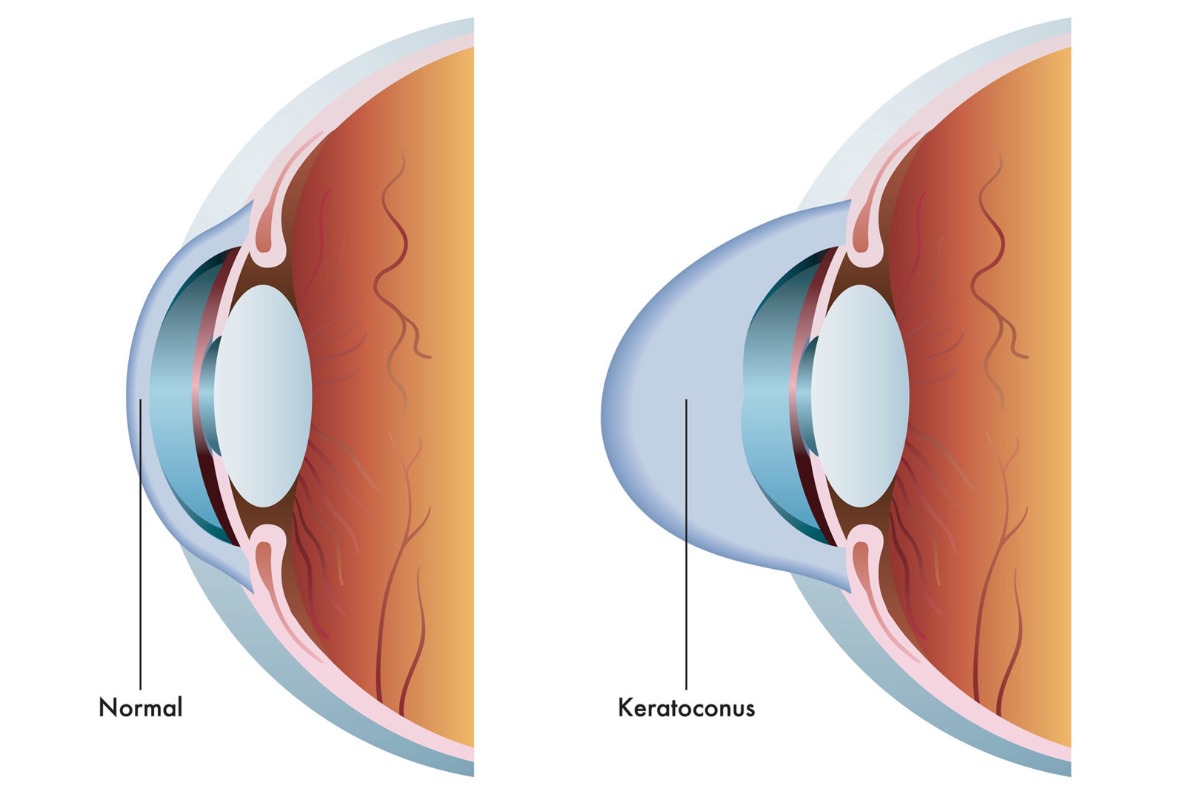
Keratoconusis a progressive eye disease that affects the cornea, the transparent front part of the eye. Under normal conditions, the cornea has a regular, slightly convex shape, which is essential for ensuring that images are focused correctly on the retina. In keratoconus, however, this structure thins and takes on an irregular conical shape, causing increasingly pronounced visual distortions.
Keratoconus is a non-inflammatory disease that tends to manifest itself in young people, between adolescence and the age of 30. In many cases, it has a genetic component, but it can also be caused by factors such as frequent rubbing of the eyes, eye allergies, or alterations in corneal collagen.
Keratoconus is a progressive disease: failure to treat it promptly can mean that, in advanced stages, a cornea transplant may be necessary.
For this reason, it is important to pay attention to certain symptoms such as blurred and distorted vision, increased sensitivity to light (photophobia), rapid worsening of refractive error, and difficulty tolerating traditional contact lenses.
Cross-linking (CXL)is currently the standard treatment for halting or significantly slowing the progression of keratoconus. It does not "heal" the cornea in the sense of restoring its original shape, but it strengthens its structure, making it more stable over time.
Cross-linking utilizes the combined action of riboflavin(vitamin B2) applied to the cornea and UVA ultraviolet light.
This interaction creates new chemical bonds—known as "cross-links"—between the corneal collagen fibers, increasing the stiffness and strength of the tissue.
There are two main approaches:
• Epithelial CXL: involves removing the outermost layer of the cornea to facilitate riboflavin penetration. This is the standard and most established method.
• Transepithelial CXL (epi-on): does not require removal of the epithelium, is less invasive and has a faster recovery time, although its effectiveness may be slightly lower in more advanced cases.
The treatment lasts an average of 30–60 minutes and is painless thanks to topical anesthesia.
CXL is an effective solution, especially when performed in the early or intermediate stages of the disease. The main benefits include:
• halting or slowing the progression of keratoconus,
• reduced risk of more invasive procedures, such as corneal transplantation,
• long-term maintenance of visual quality,
• Moderate improvement in vision possible in some patients.
Identifying keratoconus in its early stages is crucial. Through specific tests such as corneal topographyand pachymetry, the ophthalmologist can assess the shape, thickness, and evolution of the cornea. The earlier the intervention, the greater the chances of preserving vision and preventing future complications.
Keratoconus is a condition that can significantly affect quality of life, but today there are effective tools to manage it. Corneal cross-linkingis a safe, scientifically validated treatment that can stabilize the disease in most cases.
At Life Clinic, we offer comprehensive diagnostic pathways and personalized treatments for the management of keratoconus, using state-of-the-art technology and a patient-centered approach.