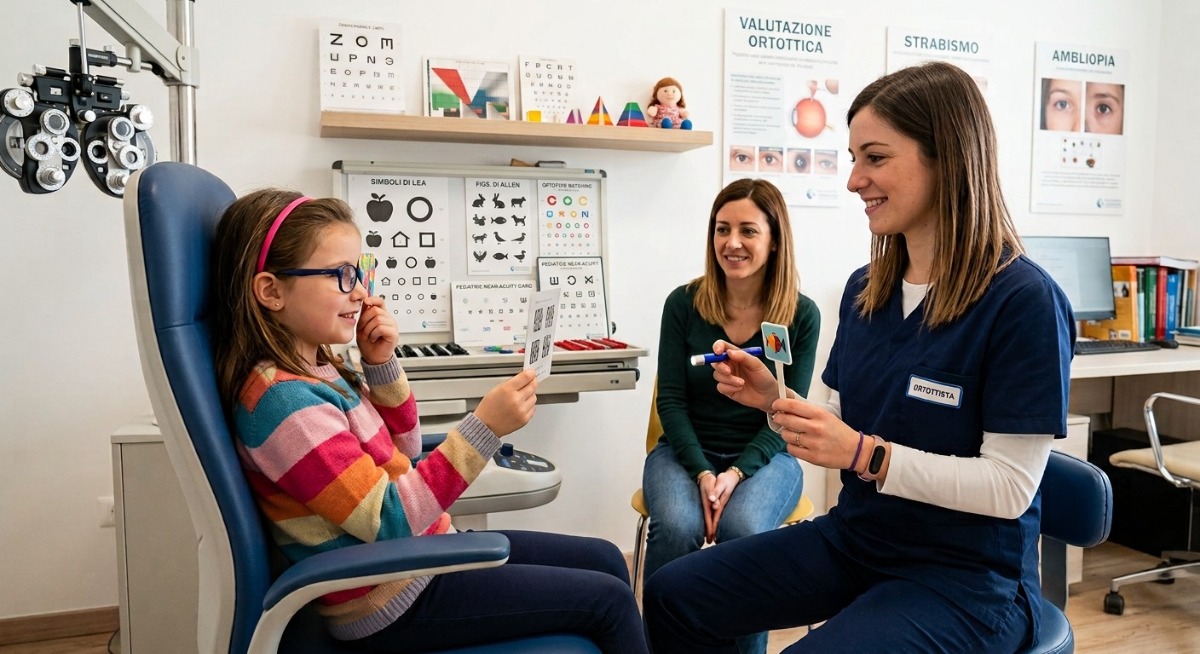
An orthoptic evaluation is a specialized examination designed to diagnose or rule out abnormalities in binocular vision, eye movements, and coordination between the two eyes (such as strabismus, amblyopia, or “lazy eye,” and heterophoria or latent strabismus).
The visit is completely painless and non-invasive; it lasts between 20 and 60 minutes and includes several instrumental and clinical steps.
The orthoptist alternately covers and uncovers one eye to assess the presence of manifest or latent strabismus and the ability to fixate.
The professional has the patient follow a small light or a pen with their eyes in various directions to observe the action of the extraocular muscles.
Special charts or goggles are used to test the brain's ability to fuse the two images from the eyes into a single 3D perception. This phase is called the stereopsis test.
Convergence is assessed—that is, the eyes’ ability to converge toward the nose as an object approaches.
When the patient is a child, the orthoptist uses charts or devices—known as pediatric optotypes—to measure the visual acuity of children who are not yet able to read letters or numbers. These are simple devices or panels that display drawings, symbols, graphics, or letters in various orientations.
Prevention and early intervention are crucial in childhood, since the visual system develops during the first years of life.
The first neonatal screening is recommended within the first 6 months and is generally performed by the pediatrician to rule out malformations or early-onset strabismus.
At around 3 years of age, it is possible to perform the first comprehensive orthoptic evaluation. At this age, the child is able to cooperate by responding verbally or with gestures, and this is the crucial age for correcting a lazy eye, or amblyopia.
Then, by preschool age—at age 6—it is recommended to screen for visual coordination problems that may affect reading and writing.
In adults, an orthoptic evaluation is recommended in cases of double vision (diplopia), eye strain (asthenopia), prolonged use of computer monitors, trauma, or following surgery, if requested by an ophthalmologist.
It is essential to pay attention and recognize warning signs early on, since a child’s visual system is extremely adaptable up to the age of 6 or 7, a period during which treatment is most likely to yield positive results.
The warning signs that may indicate the need for an orthoptic evaluation in children vary by age, but they often manifest as unusual postural habits, specific visual behaviors, or difficulties with schoolwork and close-up tasks.
It is important to pay attention to direct visual cues such as a deviation in the direction of one eye, rubbing or constant blinking of the eyes, closing one eye when the child is trying to focus on something or when looking at direct light, and an abnormal head position when trying to focus on an object or image.
There are also early signs related to behavior and learning, such as getting too close to objects in order to focus on them, frequent headaches or eye strain, losing one’s place while reading or writing, and difficulties with motor coordination.
If you notice even just one of these signs on a regular basis, you should consult your pediatrician to request an orthoptic evaluation and a pediatric eye exam.
From prevention to rehabilitation: at Life Clinic, orthoptic evaluation is the key tool for identifying binocular vision disorders and safeguarding the visual well-being of every patient, regardless of age.